Abstract
Over 96 million children received deworming treatment in the 2014-2015 school year.
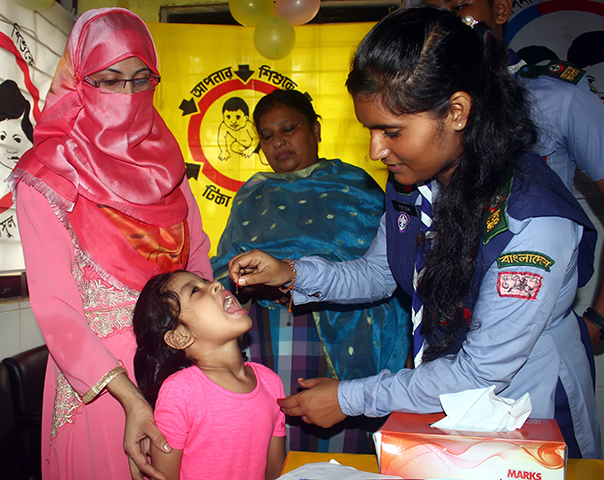
School-based deworming is a low-cost program that takes advantage of existing school infrastructure and trains teachers to administer deworming treatment—safe tablets—to all primary school students on dedicated “deworming days,” once per school-year. Because the tablets are inexpensive relative to diagnosis, which requires analysis of a stool sample in a laboratory, the World Health Organization (WHO) recommends periodic mass school-based treatments in areas where more than 20 percent of children have worm infections. Research by Michael Kremer and Edward Miguel showed that school-based deworming of students significantly improved health and school attendance in Kenya. Subsequent research showed that deworming also increased the percentage of girls who passed a primary school exam and attended secondary school, and increased non-agriculture hours worked and income for men who received treatment as children. The benefits have also passed to their children, who have shown better health, socioemotional development, and cognitive skills. In response to the evidence, school-based deworming campaigns have been scaled-up in Ethiopia, India, and Kenya, reaching over 191 million children to date.2
The Challenge
The WHO estimates that over 880 million school-age children are in need of treatment for intestinal worms, which are transmitted through contact with water or soil contaminated with fecal matter.1 Worm infections can reduce the absorption of nutrients in the body, leading to anemia and malnutrition, and weaken the body’s immunological response to other infections such as malaria. Infected children may become too sick to attend school or too tired to concentrate in class. Because intestinal worms are most prevalent in poor countries where diagnosis is relatively costly, the WHO recommends periodic mass administration of anthelmintic drugs to groups of people in worm endemic areas. Oral deworming drugs are extremely effective with a single dose, at a cost of a few cents per tablet, and are safe for those without worm infections. Periodic administration every 6–12 months addresses reinfection and the health problems associated with high wormload.
The Evidence
From 1998 to 2001, Michael Kremer and Edward Miguel evaluated the Primary School Deworming Project in Kenya. This program provided deworming tablets for soil-transmitted intestinal worms and schistosomiasis, as well as an instruction on how to avoid worm infections, to children in 75 primary schools in rural Busia, Kenya. At a cost of less than USD 0.60 per child per year, school-based deworming reduced serious worm infections by 61 percent and reduced school absenteeism by 25 percent. There were positive spillovers to children from reduced disease transmission among untreated children within treatment schools and for children who attended schools within three kilometers of treatment schools. Unlike previous studies, researchers quantified these spillover effects and showed that previous studies had underestimated the benefits of deworming.
A long-term follow-up found that deworming also improved school performance and future earnings. Deworming led to large academic gains for girls, increasing the rate at which girls passed the secondary school entrance exam by 9.6 percentage points over the comparison group mean of 41 percent. Men who were dewormed as children worked 3.5 more hours per week, spent more time in entrepreneurial activities, and were more likely to work in higher-wage manufacturing jobs than their untreated peers.
Furthermore, recent evidence suggests that the benefits of deworming can even extend to the next generation. Children of parents who were dewormed in the 1998-2001 study have exhibited better health, socioemotional development, and cognitive skills (prior to the COVID-19 pandemic) compared to their peers whose parents were not dewormed.
In our Student Participation cost effectiveness analysis, we estimate that school-based deworming adds 14 years of education per USD100 spent. Among interventions that have been rigorously tested by randomized evaluations, school-based deworming is one of the most cost-effective means of increasing school attendance.
The Impact
In response to the evidence, school-based deworming campaigns have been scaled-up in Ethiopia, India, and Kenya, reaching over 191 million children to date.2
In 2007, Michael Kremer and Esther Duflo presented evidence on the impact of school-based deworming to the Young Global Leaders Education Task Force at the World Economic Forum Annual Meeting in Davos, Switzerland. In response, Deworm the World (DtW) was launched as an independent organization to coordinate technical assistance and advocacy efforts for sustainable, large-scale school-based deworming programs. To support the growth of the program, Innovations for Poverty Action incubated DtW from 2010-2014. DtW is now a program of the nonprofit organization Evidence Action, which builds long-term partnerships and provides technical assistance to help governments launch, monitor, and sustain school-based deworming programs.
In 2009, Kenya’s then-Prime Minister Raila Odinga announced the start of the National School-Based Deworming Program at the World Economic Forum Annual Meeting. The Program is now a collaboration between the Kenyan ministries of Education, Science, and Technology and Health. In the 2014-2015 school year, Kenya’s National School-Based Deworming Program treated 6.17 million children across the country.
In 2010, the Abdul Latif Jameel Poverty Action Lab (J-PAL) hosted a conference with the Government of Bihar, a state in India, to share evidence on school-based deworming and other promising programs. Following these discussions, the Government of Bihar, with support from Deworm the World, launched a state-wide deworming campaign in 2011, which reached 17 million children. Other large-scale deworming programs in India were implemented in Andhra Pradesh, Delhi, and Rajasthan. In February 2015, the Government of India launched a national deworming program and in October, India announced it had treated 89.9 million children in 11 states since the launch of the campaign. In 2016, India’s school-based deworming program is aiming to reach 200 million children ages 1-19 in schools and preschools across all 29 states and seven union territories.
Incorporating best practices from India and Kenya, the Government of Ethiopia also launched a national school-based deworming program in 2015 which aims to distribute more than 100 million treatments in all endemic areas by 2020.
Altogether, the continued uncovering of positive health and economic impacts of deworming treatment across generations underscores its effectiveness in transforming livelihoods for families in low- and middle-income countries.
This work is licensed under a Creative Commons Attribution 4.0 International License.
Sources
1. http://www.who.int/intestinal_worms/more/en/
2. This figure should not be interpreted as the number of unique children dewormed, as some children participated in multiple years of the deworming program as part of periodic administration.