




Policy Issue:
Many small-scale farmers in the developing world face significant income uncertainty, and rural farmers who live from harvest to harvest don’t have much room for error. Variables beyond the farmers’ control, such as fluctuating crop prices, can make a significant difference in how much a family earns for the year. Farmers may be unwilling to take on additional risks by borrowing and making long-term investments due this uncertainty. This reluctance is thought to contribute to the decision of many farmers not to invest in technologies such as hybrid seeds, fertilizer, or irrigation that could potentially improve crop yields. Many lenders are also extremely wary of extending credit to farmers, fearful that they will inherit the risks inherent to farming. Crop price insurance could help solve this problem, reducing the risk to farmers and providing them with encouragement to make investments in their farms. Lenders, too, may feel more confident in lending to farmers with greater income certainty, facilitating even more capital investments.
For new democracies and societies emerging from conflict, encouraging tolerance and dialogue, strengthening non-violent conflict resolution systems, and increasing understanding of human rights are key priorities. Governments and NGOs commonly try to change the political culture, civic values, and practices of conflict resolution at the local level through widespread dialogue, education, and information campaigns. But do these dialogue and education programs actually work as intended? Do they change norms and behaviors, and if so, how? How are new patterns of conflict resolution formed? And how do they contribute to national reconciliation? How do new state structures integrate with pre-existing local bodies to jointly support security goals and human rights, especially where traditional structures are in conflict with the later? In short, what programs are most useful in helping post-conflict countries achieve lasting peace?
Policy Issue:
Savings are crucial for managing irregular and unpredictable cash flows in order to meet daily needs, finance lumpy expenditures, and deal with emergencies. For poor households, informal tools like credit from moneylenders are often less efficient than savings mechanisms as they require high interest rates to finance predictable and recurring expenses. Evidence suggests that these households often have excess financial capital after covering subsistence expenses that could be used for savings. Access to and utilization of financial products that help the poor save funds for the future may have substantial welfare consequences.
The recognition of this need has led to the creation of greater financial access throughout the developing world. Banks, for instance, have increased their reach over the past decade in Sub-Saharan Africa, offering savings accounts with minimal fees and opening requirements. Take-up of formal savings accounts among the poor, however, remains low. Why do poor individuals fail to take advantage of the lower-risk, lower-cost vehicle for saving that bank accounts offer? This study evaluates the relative importance of individual beliefs, psychological factors, and transactional barriers to opening accounts.
Youth unemployment is widely considered a threat to development and to security. In the least developed nations, where firms are rare, aid-based employment interventions commonly provide inputs into self-employment to reduce poverty and social instability. Such programs are rooted in at least three assumptions. The first is that poor people have agency and are capable of making informed economic decisions. The second is that the poor possess high returns to investments but are constrained from reaching those returns unaided. The third is that increased income reduces youth alienation and aggression. This evaluation looks for evidence of all three claims in Uganda’s largest employment program.
Policy Issue:
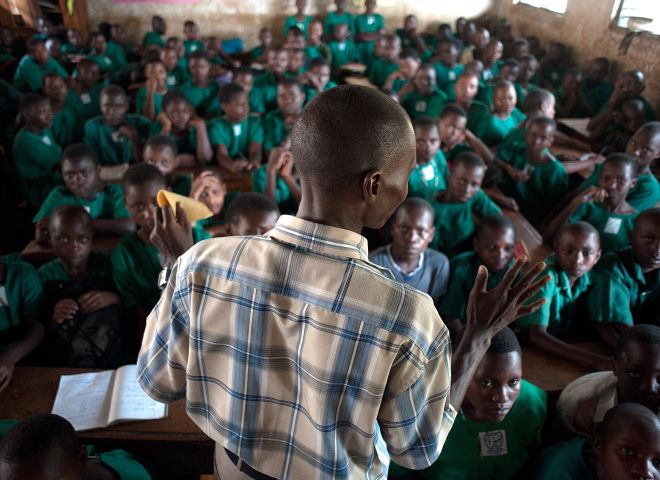
Surveys on financial knowledge and behavior have revealed that individuals in both developed and developing countries around the world lack adequate knowledge to make informed financial decisions. Empirical evidence demonstrating correlations between financial literacy and various measures of well-being has directed service providers, donors, and policymakers to include financial training and business education programs as part of broader anti-poverty strategies. Financial education, especially when provided in the early stages of life, has the potential to create long-lasting impacts. Intuitively, financial education provides useful tools to people of all ages, yet empirical evidence for this impact is thin and often mixed. This project tests two financial education curricula for primary school students. Specifically, it measures the impact of financial education on student behavior attitudes, and outcomes.
To address the global challenge of sickness from cholera, diarrhea and typhoid, Innovations for Poverty Action developed the chlorine dispenser system – a...