

About
In the aftermath of instability and conflict, addressing core issues such as unemployment, food security, education, health, and financial access are particularly complex. Responding to such challenges is essential as development indicators are dramatically lower and poverty levels are dramatically higher in post conflict areas. According to the World Bank’s World Development Report 2011, “People in fragile and conflict-affected states are more than twice as likely to be undernourished as those in other developing countries, more than three times as likely to be unable to send their children to school, twice as likely to see their children die before age five, and more than twice as likely to lack clean water.” While trends show that poverty is declining for much of the world, countries affected by conflict are falling behind. As an indication of this, no low-income, fragile or conflict-affected country has achieved a single Millennium Development Goal.
Assisting countries recovering from conflict and disasters and working towards preventing future instability remains a major challenge for the international community currently. In recognition of this, there has been a proliferation of programs in post-conflict and fragile states attempting to build stability and move towards economic growth. However evidence on what works in promoting economic gains and development, and ensuring peace and security building remains scarce.
Innovations for Poverty Action is working with local governments, leading academics and NGOs on the ground to conduct some of the first rigorous randomized evaluations of projects focused on peace-building and the unique set of challenges facing post-conflict and fragile states. With a broad range of contexts in need of evidence, IPA aims to identify programs that work both in response to uniquely challenging post-conflict contexts as well as programs that address issues more widespread across developing economies. IPA is currently conducting evaluations in Liberia, Sierra Leone, northern Uganda and Cote d’Ivoire which address a range of issues including youth employment, intimate partner violence, ex-combatant reintegration, community driven development and female entrepreneurship. The priority sectors of the Post Conflict Recovery and Fragile States Initiative are Education, Youth Employment, and Disarmament, Demobilization and Reintegration.
Disarmament, Demobilization and Reintegration (DDR)
Disarmament, Demobilization and Reintegration programs are resource intense undertakings central to the transition from conflict to peace. Tasked with leading tens or hundreds of thousands of combatants through the transition from war to productive peace, DDR programs require budgets of over $400 million per country, yet to date have not been systematically and rigorously evaluated. A range of actors lead DDR efforts using varying program models, including job skills training, educational programming and psycho-social components for different lengths of time and levels of intensity. Recent evaluation results from Liberia show mixed results and begs further research but suggests that programs can increase ex-combatant engagement in productive livelihoods. Governments, policymakers, international organizations and donors alike require more evidence on the program models which lead to the greatest impact and sustained long term outcomes.
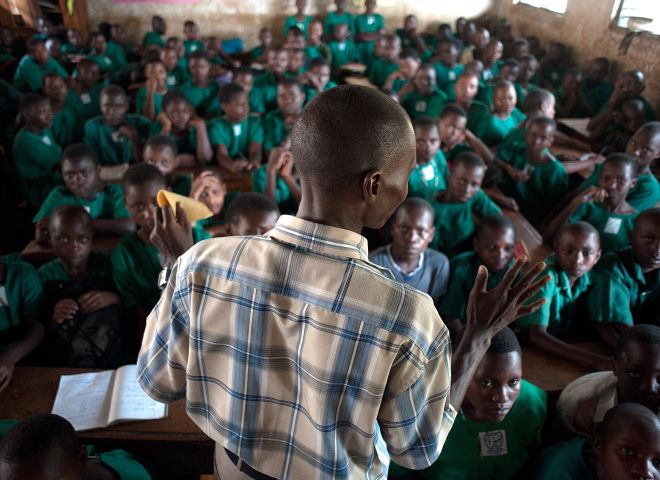
Countries affected by conflict struggle to achieve high levels of school enrollment, to provide quality instruction, and reach minimum levels of literacy and numeracy among children and youth. Making gains in the educational sector is essential for future improvement of public service delivery, development and expansion of industry, commerce and trade, sustained gains in health, nutrition and household well-being, and financial improvements on the individual and national levels. Little evidence exists around the strongest program models, essential elements and overall impact of post-conflict educational programs.
The number of youth in developing countries in staggering; almost a third of the world population in a developing country are between 15 and 34 years old. And of great concern to governments and the international community, youth unemployment rates are disproportionally high, often between 15-40%. Many large scale programs are launched to provide training and job skills to this population, but little rigorous evidence exists on the most cost-effective models or on realistic program impacts. Initial evidence from a new report suggests that low-intensity interventions can make a sizable improvement in youth income generation and employment levels. Further evidence is required to better understand the link between youth employment, instability and conflict, and to identify promising and scalable models.
